TIEMPO COTEC
A Planetary Instrument in Real Time
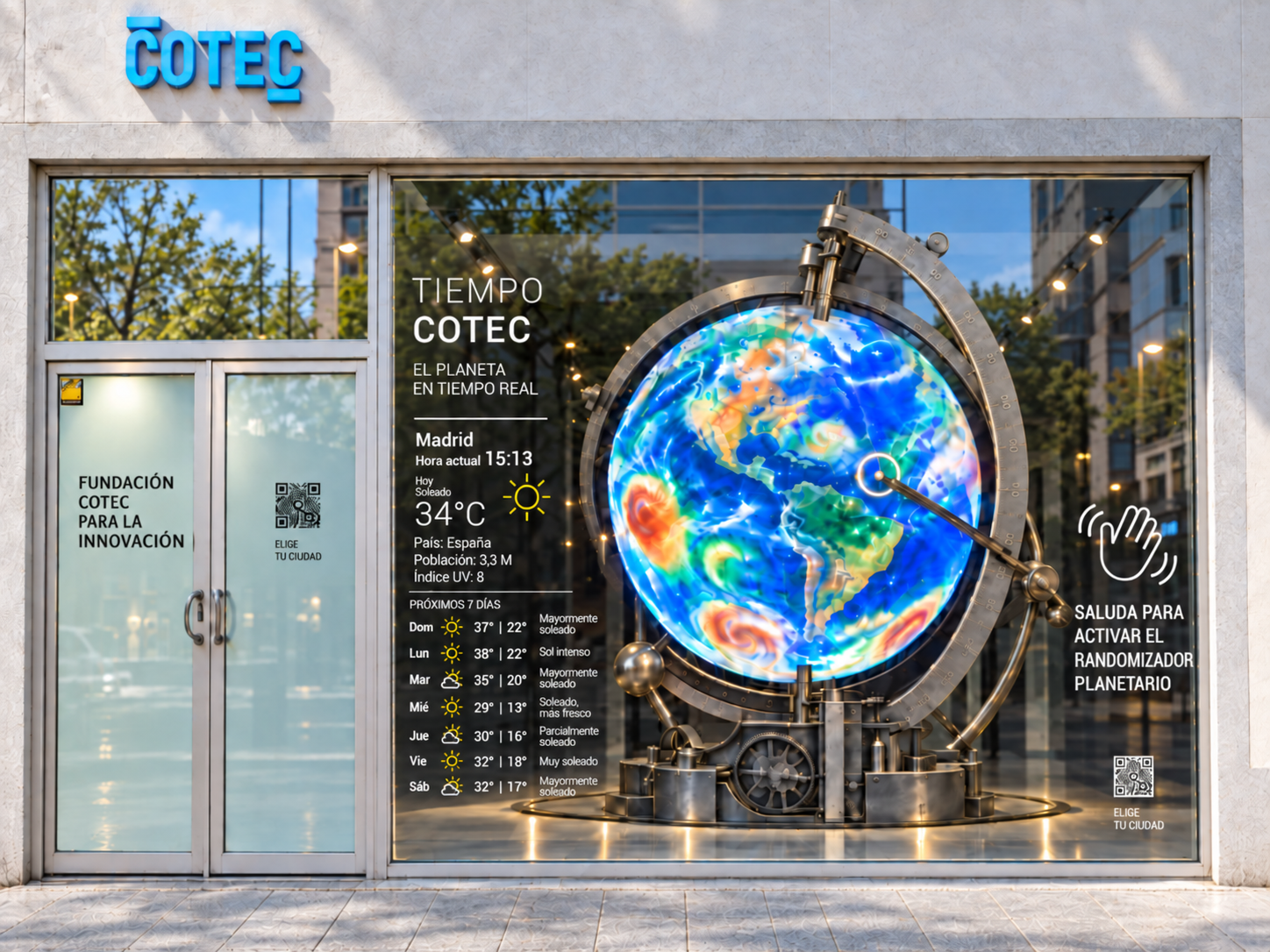
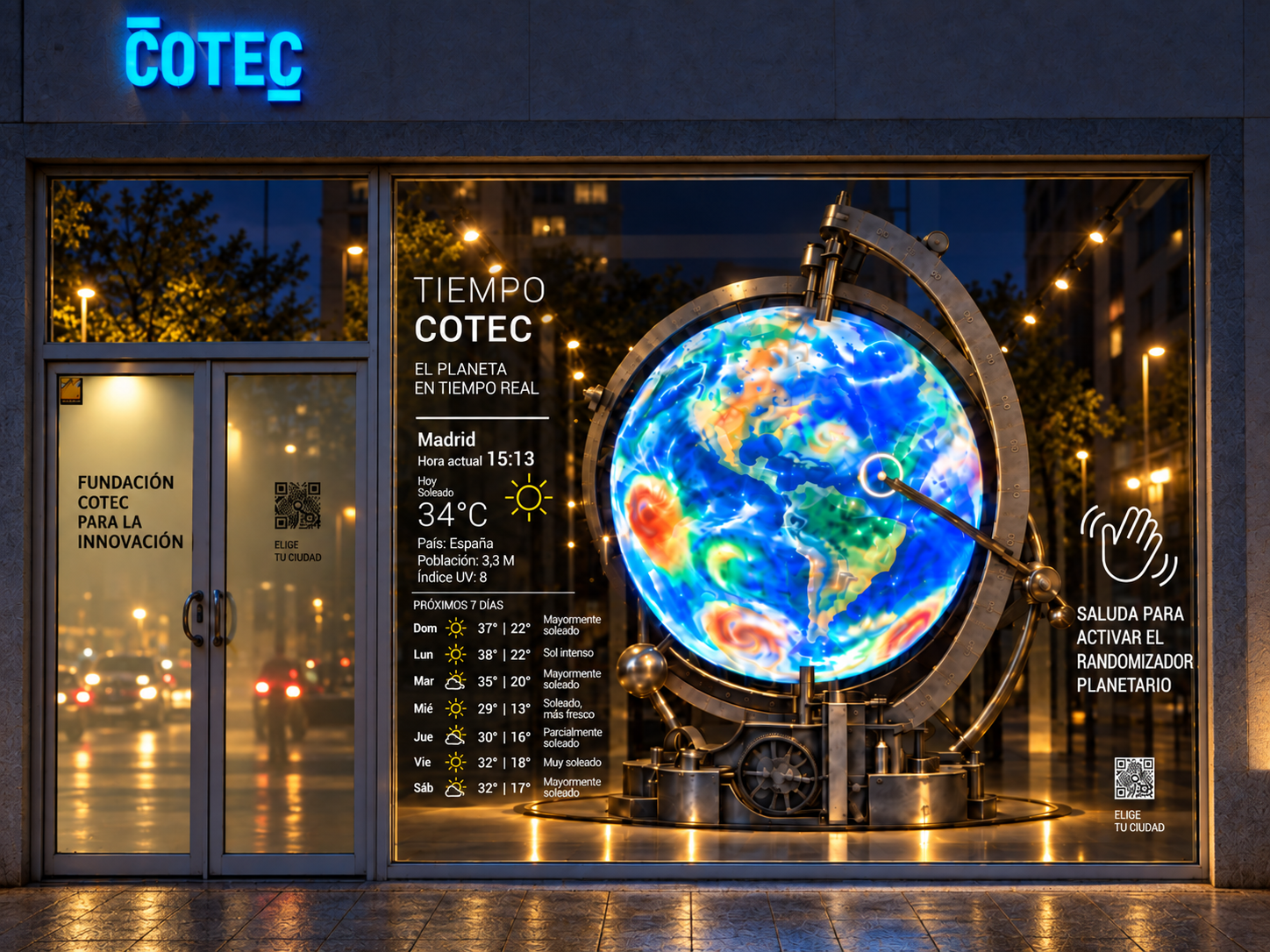
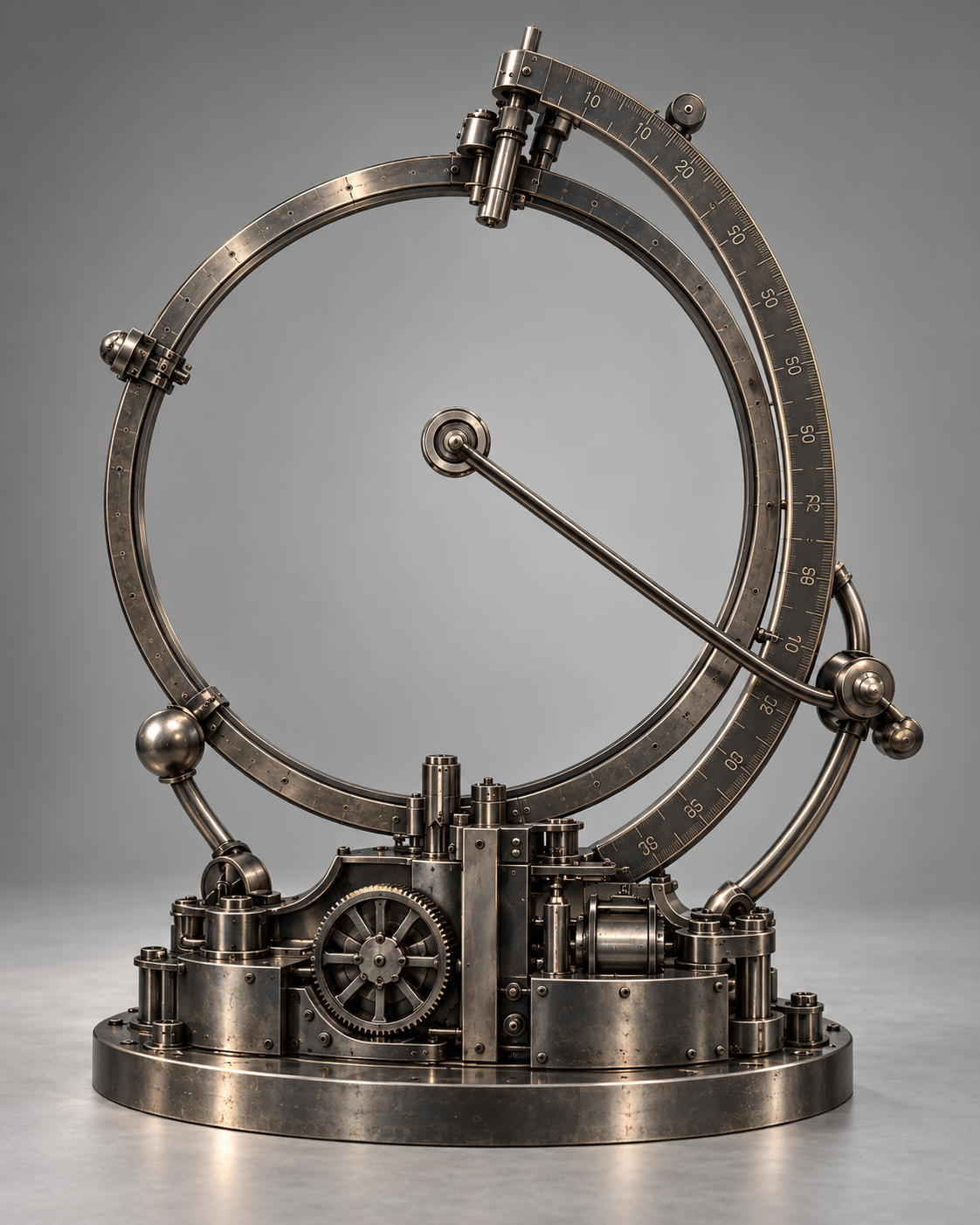
TIEMPO COTEC is a real-time planetary artwork that explores the Earth city by city, transforming each location into a changing portrait of place, time and atmosphere. At its centre, a luminous sphere generates evolving AI-assisted visualisations from live global weather data, translating temperature, wind, pressure, humidity, cloud cover and precipitation into colour, texture and movement. Around it, a handmade kinetic structure inspired by armillary spheres and historical astronomical instruments physically reorients its rings and pointer toward the coordinates currently being explored. Weather becomes a constantly shifting lens through which distant places can be encountered.
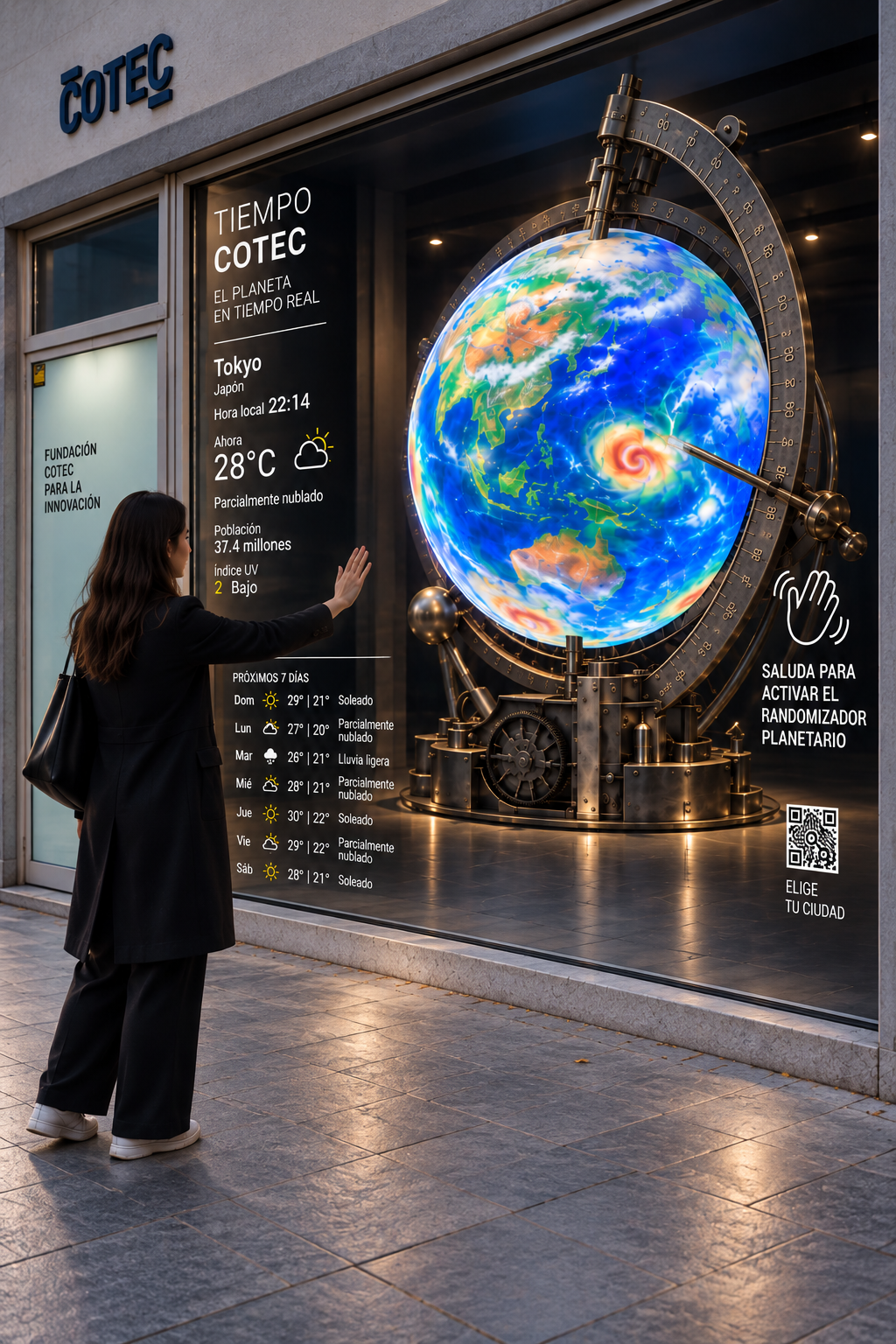
Driving the installation is the Planetary Randomiser, a custom system that sends the work on an ongoing journey around the world. Approximately every thirty seconds, it selects a new city, moving unpredictably between continents, climates and time zones. When someone approaches the KNOWCASE window, a privacy-preserving proximity sensor immediately triggers another destination, causing the sphere, mechanical instrument and information display to transform together and reveal the new city through its position, local time and live atmospheric conditions.
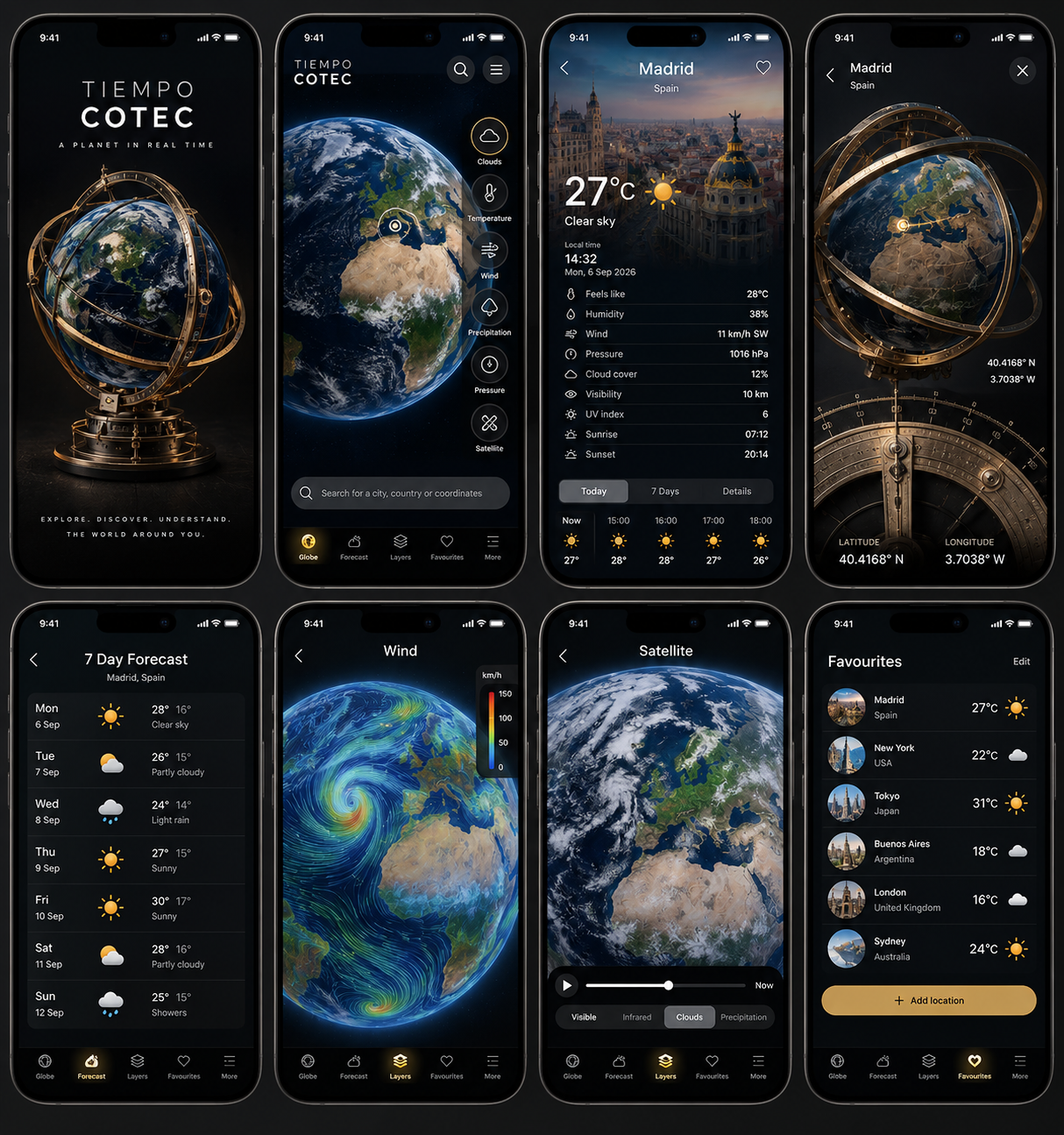
The TIEMPO COTEC digital application extends this journey beyond the physical installation. Accessible instantly by QR code as a browser-based experience, and optionally through the App Store or Google Play, it allows users to rotate the Earth, activate the randomiser, search for cities or select any location themselves. Each destination becomes a compact live portrait combining geographic position, local time, current atmospheric conditions and forecast information, creating a personal version of the same planetary instrument.
TIEMPO COTEC brings together scientific observation, artificial intelligence, custom software, projection, digital information systems, mechanical engineering and handmade fabrication within a single functioning machine. Conceptually, it connects the historical armillary sphere—an instrument for locating ourselves within the world and cosmos—with the contemporary algorithm, capable of navigating a planet described through satellites, sensors, coordinates and data. Its central question is not simply how we predict weather, but how we encounter and understand a world that can now be sensed simultaneously from thousands of distant points. Designed for the street-facing KNOWCASE space, the installation becomes a continuously changing window onto the planet.
FROM ARMILLARY SPHERE TO ALGORITHM
TIEMPO COTEC sits between art, science, digital culture and the history of technology. Its subject is not weather alone, but the experience of moving through the world city by city, using live atmospheric data as a way to encounter distant places in real time.
Inspired by the armillary sphere, which translated celestial systems into physical rings, axes and movement, the work traces a shift from mechanical instruments to the modern algorithm. Today, satellites, numerical models and software process planetary information largely invisibly. TIEMPO COTEC makes this infrastructure tangible again: coordinates become movement, atmospheric conditions become image and light, and computation acquires physical form.
At its centre, the Planetary Randomiser turns the installation into an ongoing journey across the Earth. Each selected city activates a new combination of geographic position, local time and live atmospheric conditions, simultaneously transforming the AI-assisted sphere, transparent display and mechanical coordinates. The work therefore evolves as a sequence of planetary encounters rather than repeating a fixed forecast.
AI interprets verified meteorological data rather than inventing it, translating the specific atmosphere of each place into a changing visual language. Set against handmade mechanics, the work creates a dialogue between the armillary sphere and the algorithm—between historical instruments of orientation and contemporary systems for sensing the planet, and between physical exploration and a world increasingly understood through data.
THE PLANET WE CHOOSE TO LOOK AT
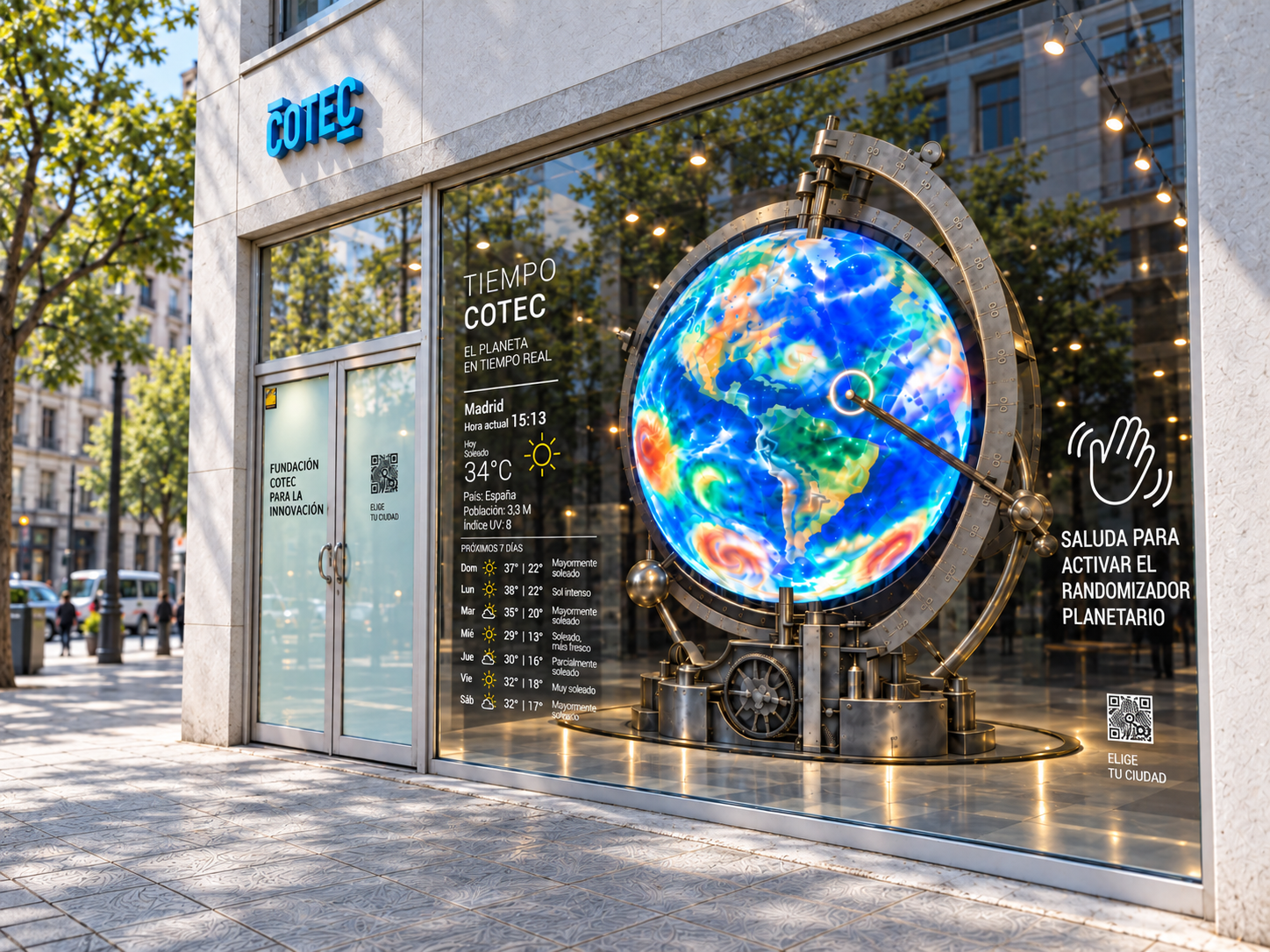
TIEMPO COTEC is designed for the street-facing condition of KNOWCASE, where interaction begins without a phone or interface. A privacy-preserving proximity sensor detects an approaching visitor and immediately activates the Planetary Randomiser: the globe “swooshes” across the planet, selects a new city, updates its live weather data and local time, generates a new atmospheric visual state, and mechanically realigns toward its coordinates.
When no visitor is present, the Randomiser operates autonomously approximately every thirty seconds. Human presence interrupts this rhythm, creating an immediate and visible relationship between the viewer and the machine.
A QR code opens the TIEMPO COTEC Progressive Web App, a pocket-sized extension of the work. Users can explore the globe, search for locations, view current conditions and forecasts, or activate the Planetary Randomiser to discover somewhere unexpected. The app remains independent from the physical sculpture and does not control it.
Anonymous engagement can be measured through sensor activations, QR scans, app sessions and Randomiser use, without requiring accounts or storing personal location data. Together, live data, chance, physical response and digital participation keep the installation continuously evolving rather than repeating a fixed loop.
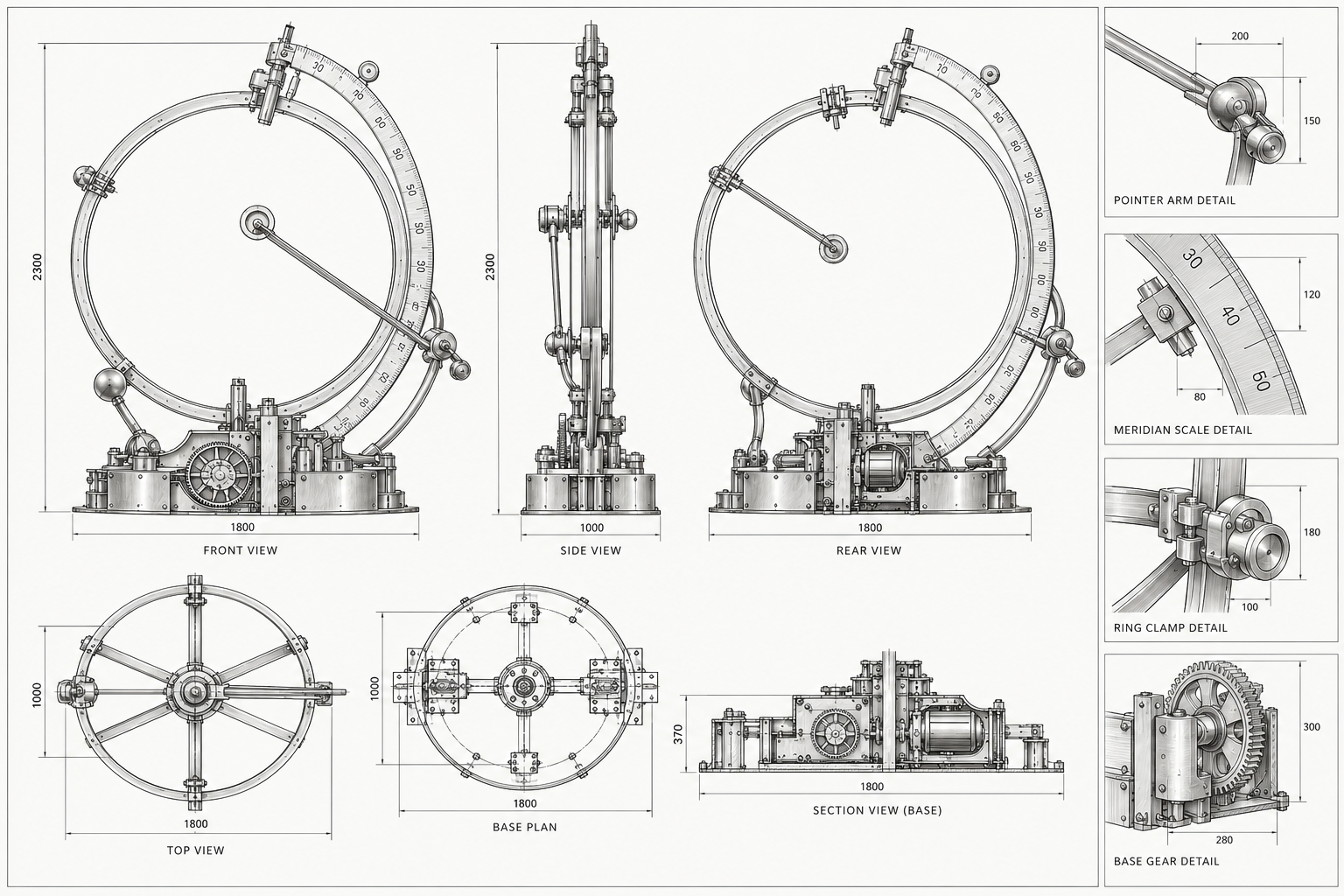
A MACHINE ABOUT HOW WE EXPLORE THE WORLD
TIEMPO COTEC sits at the intersection of art, science, digital culture and the history of technology. Its subject is weather, but its deeper concern is how planetary knowledge is produced, translated and experienced.
The work makes today’s invisible data infrastructure physical again: coordinates become movement, atmospheric data becomes image and light, and computation acquires mass and duration.
At its centre, the Planetary Randomiser connects live global data, proximity sensing, AI-assisted visualisation and mechanical movement in one responsive system. Each selected location triggers a complete transformation of the installation, allowing it to behave as an evolving machine rather than a repeating audiovisual display
AI does not generate scientific information; verified meteorological data remains the source. Instead, AI interprets relationships between atmospheric variables into a changing visual language. Placed alongside handmade mechanics and historical instrument-making, it creates a tension between analogue and digital, material and computational intelligence.
TIEMPO COTEC asks not whether new technologies replace older forms of knowledge, but how they might evolve together.
ONE DATASET — THREE PHYSICAL RESPONSES
TIEMPO COTEC connects live meteorological data, proximity sensing, AI-driven visualisation, mechanical movement and a transparent information display through a single control system. At its centre is the Planetary Randomiser, which selects the geographic location currently presented by the artwork.
When no visitor is present, the Planetary Randomiser selects a new location approximately every thirty seconds. When someone approaches the KNOWCASE window, the proximity sensor triggers an immediate new selection. The chosen coordinates retrieve live weather data, which simultaneously drives the sphere’s atmospheric visualisation, the transparent data display and the mechanical pointer and calibrated rings.
AUTONOMOUS MODE
30-second timer → Planetary Randomiser
VISITOR MODE
Proximity Sensor → Immediate Planetary Randomiser
SYSTEM FLOW
Location → Coordinates → Live Weather Data → AI Visualisation + Data Display + Mechanical Alignment
The digital application uses the same logic independently. Users can search, select a location or activate the Planetary Randomiser to discover an unexpected place and view its live weather and forecast.