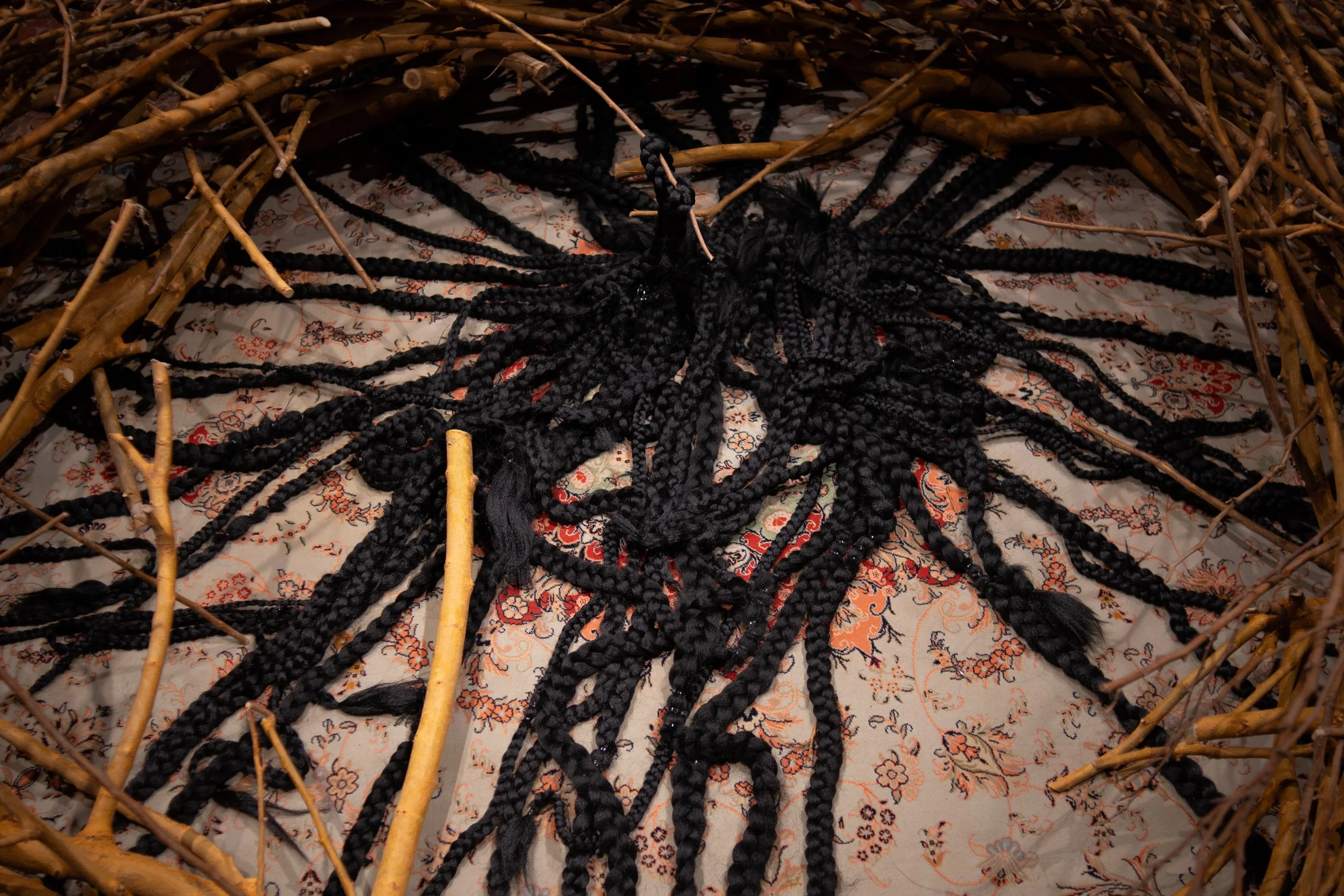
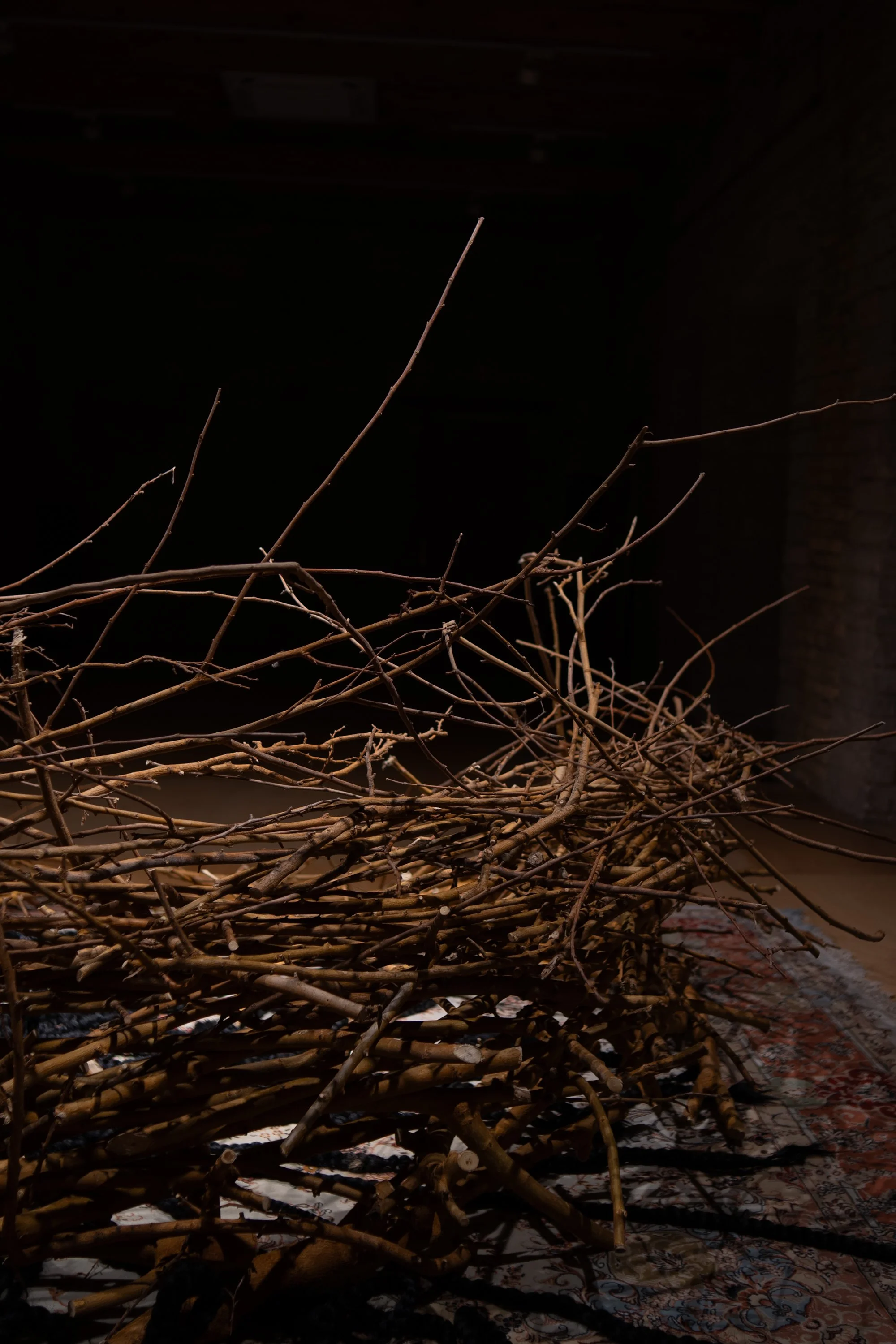
AQUILA, 2026
Multimedia installation and performance, variable dimensions
Wood, human hair, silk, mixed media, soundscape, video footage
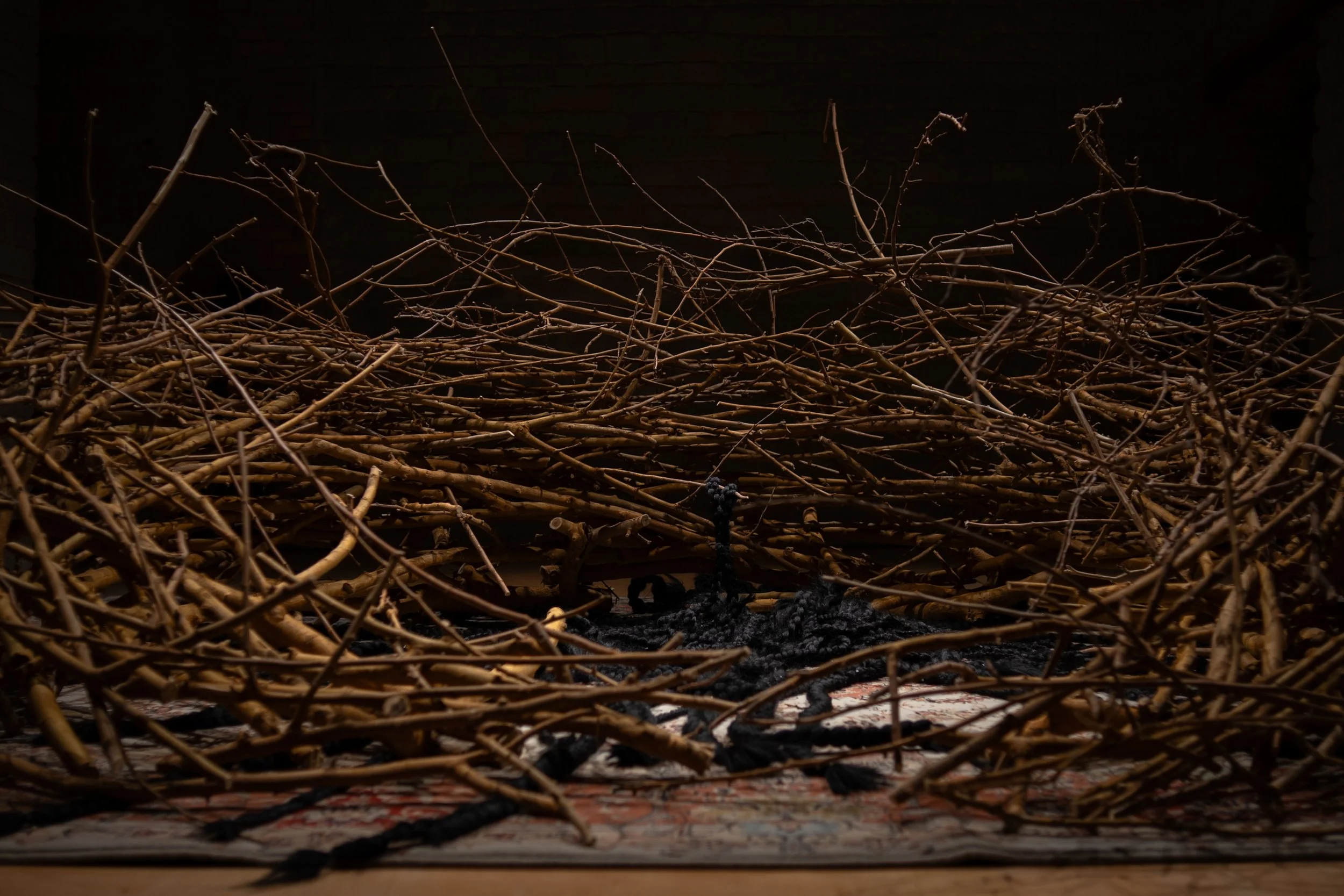
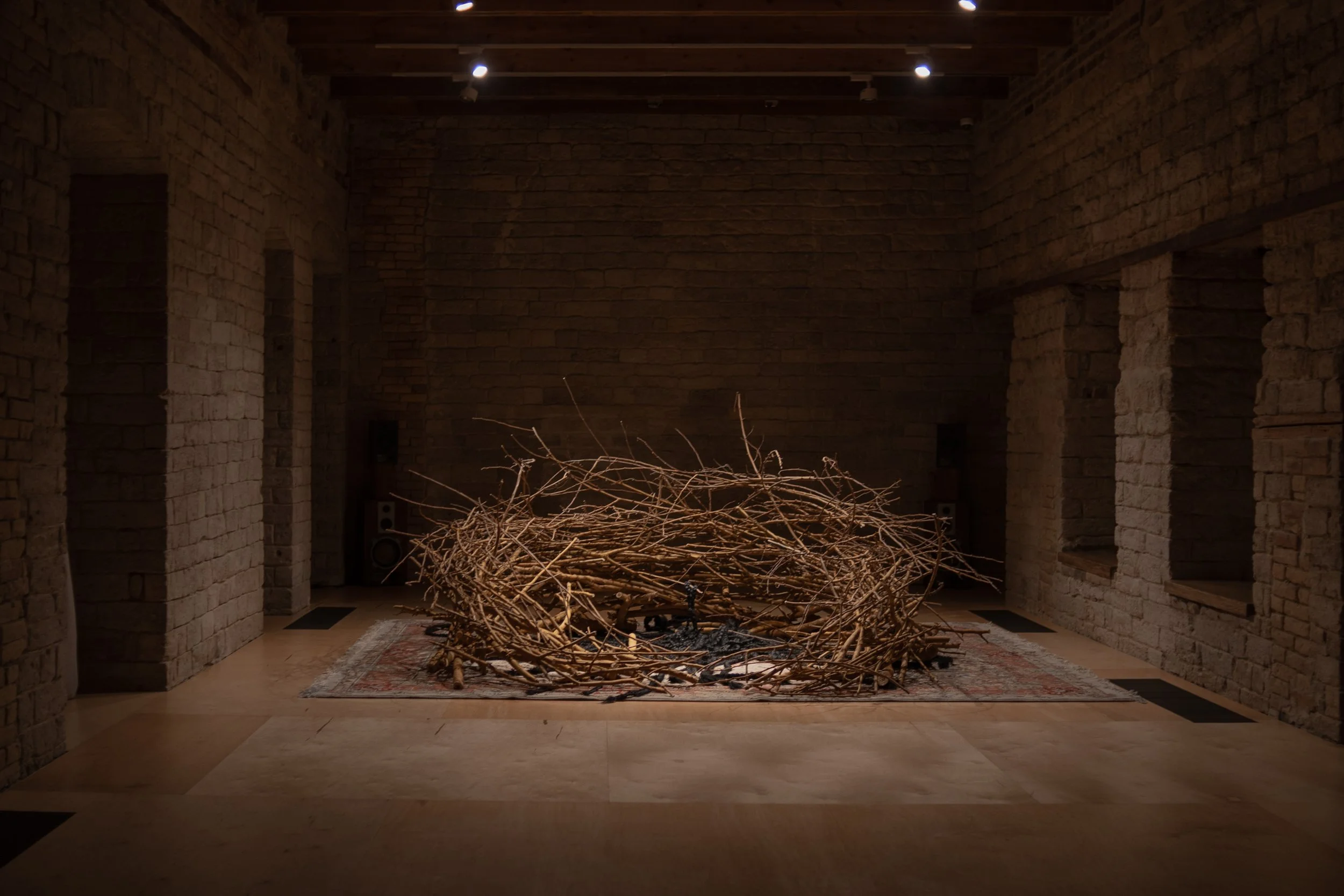
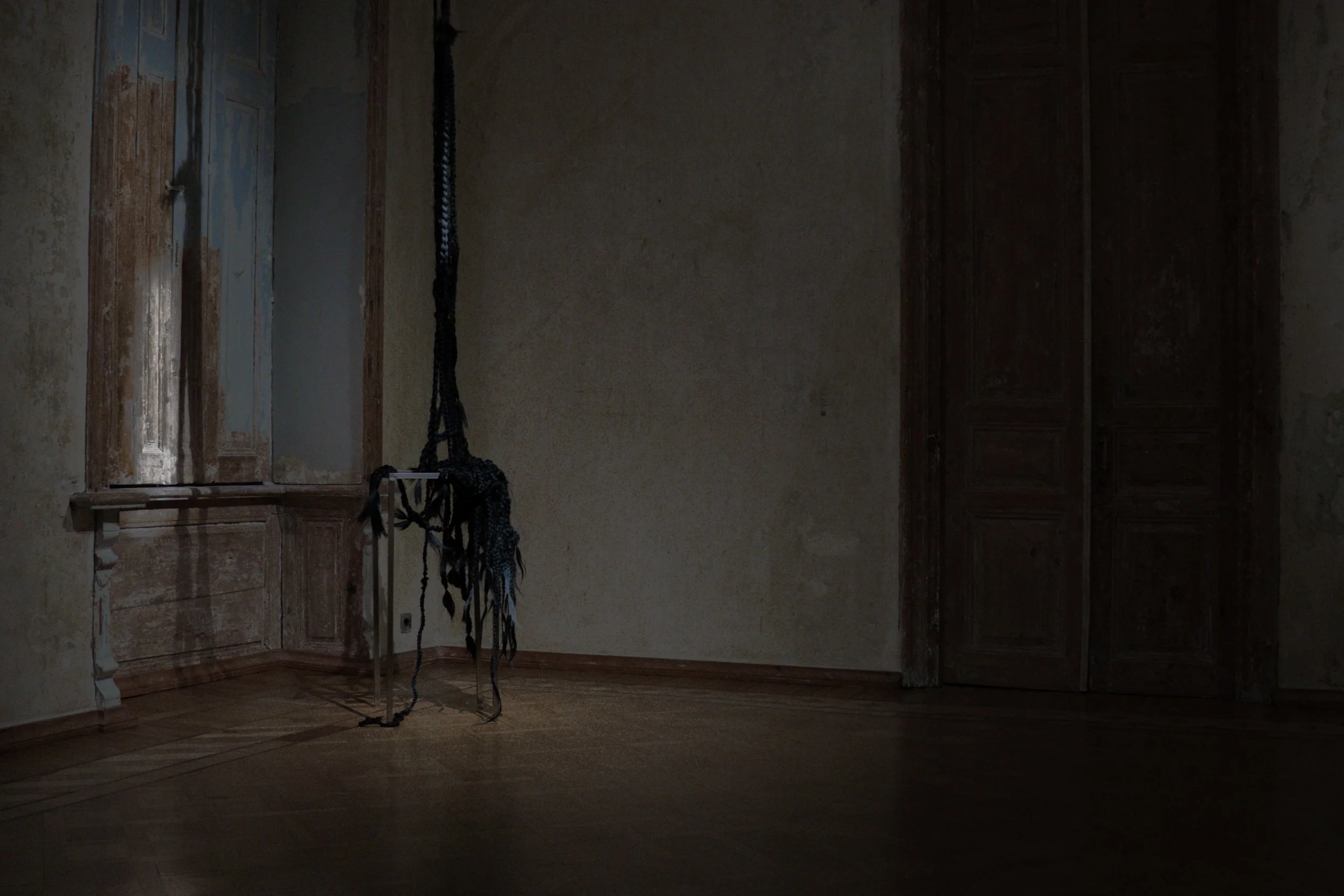
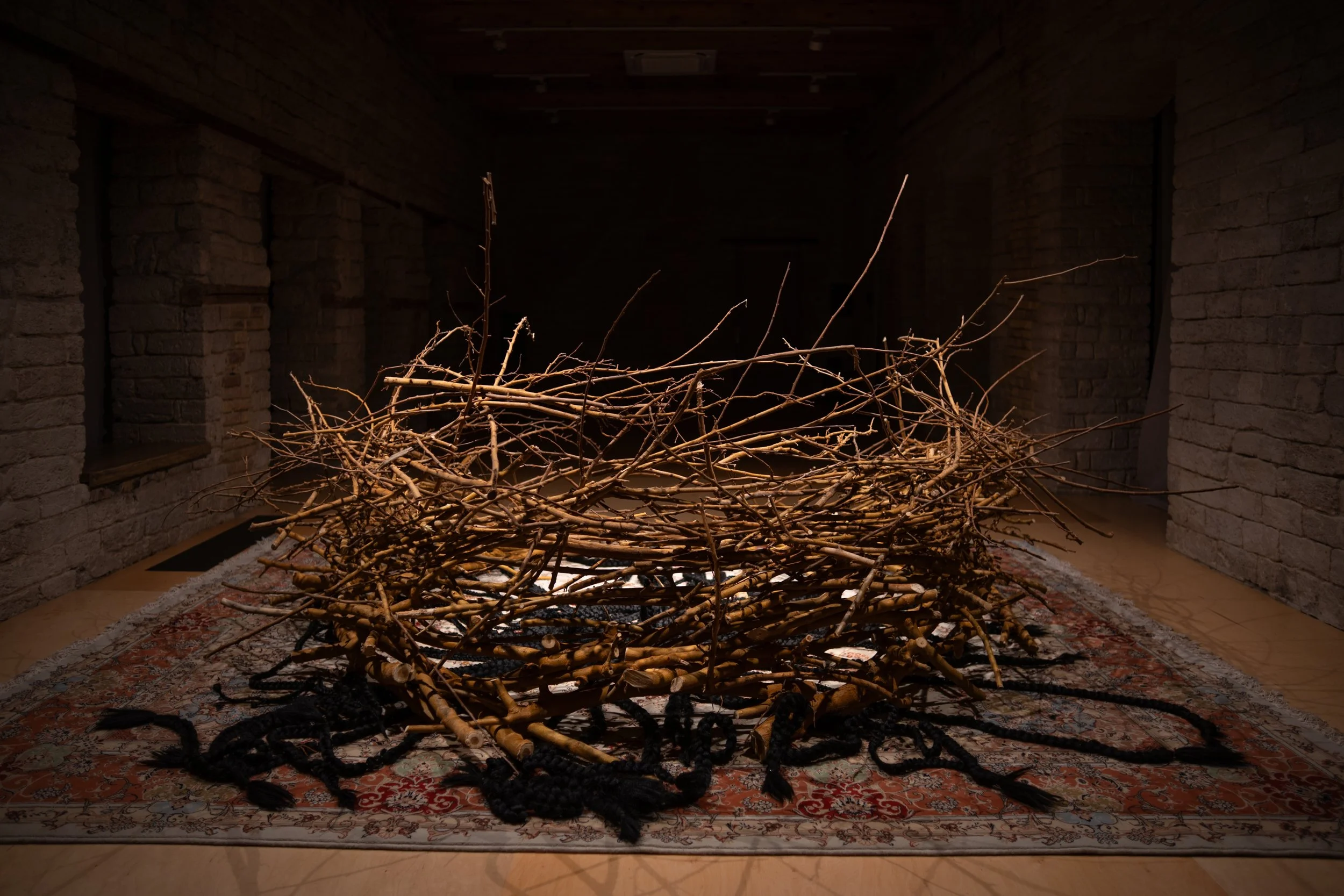
Aquila is a monumental eagle’s nest constructed from the branches of a dying mulberry tree in the artist’s garden, interwoven with long black braids. Rooted in Azerbaijan’s cultural and ecological heritage, the work transforms the remains of a tree into an architecture of survival, connecting personal memory with the vulnerability of entire ecosystems.
During the performance, the artist inhabits the nest, continuously weaving a black braid that extends beyond its boundaries. This repetitive gesture brings together human traditions of braiding and the instinctive architecture of birds, exploring inherited knowledge, belonging and ecological interdependence.
Confronting the irreversible loss of biodiversity, Aquila becomes both a monument to the fragility of life and a reflection on humanity’s responsibility toward the natural world.
A Manifesto for Biodiversity, Memory and Belonging
We have inherited a world we no longer know how to inhabit.
We measure biodiversity in species, populations and habitats, as though numbers could account for the complexity of what is vanishing. Yet every species embodies millions of years of evolution: a unique intelligence, an architecture of survival, an irreplaceable relationship with the living world.
When a species disappears, an entire way of inhabiting the Earth disappears with it.
Aquila takes its name from the eagle, an ancient symbol of sovereignty, power and transcendence. Once the emblem of Roman imperial authority, the eagle represents a sovereignty far older than any empire: that of nature itself.
Its nest is an architecture without an architect, shaped by instinct, repetition and knowledge inherited across generations. Every branch carries a relationship to the surrounding landscape. Every structure depends upon an intricate network of other lives.
No nest exists independently of the world that sustains it.
The nest of Aquila is constructed from the branches of a dying mulberry tree in my garden. A living witness to generations of family history, the tree now enters another existence: its declining body becomes the architecture of another species.
Rooted in Azerbaijan's cultural and ecological heritage, the mulberry carries centuries of coexistence between human life and the natural world. Its branches hold the memory of a home, of seasons passed, of the hands that planted, tended and lived beneath it.
In its transformation, the mortality of a single tree confronts the vulnerability of entire ecosystems.
What once sheltered life becomes an architecture of its absence.
Into this structure I weave long black braids, introducing the human body into an architecture that does not belong to it. Braiding is itself an inherited language: knowledge carried through hands, gestures and generations, a practice of continuity in the face of disappearance.
Seated within the nest, I braid continuously. The braid grows beyond the nest, crossing the boundary between human and animal, memory and instinct, shelter and displacement.
The gesture is both an act of care and an admission of dependence. I enter the architecture of another species, bringing with me the traditions of my own. Two forms of inherited knowledge meet, yet neither can replace the other.
Heritage does not belong to humanity alone.
It exists in the instincts of animals, the memory of trees, the migrations of birds, the intelligence of ecosystems and the invisible relationships that sustain life. To destroy biodiversity is to erase knowledge older than civilization itself.
Aquila confronts the limits of human restoration. A dying tree transformed into a nest cannot be brought back to life, just as no human intervention can recreate the lost intelligence of a species.
I enter the nest not as its rightful inhabitant, but as an intruder, seeking refuge in an architecture I cannot reproduce, within a living world whose destruction I cannot undo.
We cannot weave back an extinct species.
We cannot rebuild an ecosystem from its memory.
We cannot preserve our heritage while destroying the living world that produced it.
Aquila is an act of making in the face of unmaking.
A convergence of human memory, animal instinct and the remains of a dying tree.
An architecture suspended between inheritance and extinction.
Not a monument to nature as we remember it, but a confrontation with what we are allowing ourselves to lose.